


Philadelphia is throwing itself a 250th birthday party – parades, fireworks, red-white-and-blue everything. William Way’s answer is quieter, sharper, and honestly more moving. If you’ve been meaning to see it, this is your window: “This Is (Not) a Celebration: Queer Resistance 1976/2026” closes tonight, Friday, July 3, at 6 p.m. Here’s why it’s worth the trip to Northern Liberties before the doors shut for good.
Not a birthday. A reckoning.
Most of the city’s America 250 programming looks backward with a grin. This show does the opposite. It reframes 1976 – the nation’s Bicentennial – not as a moment of patriotic consensus, but as a year of LGBT+ defiance, when Philadelphians used the country’s self-congratulation as leverage to demand visibility and rights.
It’s built from the real thing. The exhibition draws on William Way’s John J. Wilcox, Jr. Archives – the most extensive collection of Philadelphia LGBT+ history anywhere – plus materials from Philadelphia Gay News. Fitting detail: both William Way and PGN launched in 1976, the same year the country was busy patting itself on the back.
The show is one node in Radical Americana, a citywide initiative from The Clay Studio linking 25 arts institutions around the semiquincentennial. Curator Jake Foster built it to counter the celebratory lens on purpose, and to puncture the comfortable myth that progress just happens on its own, gradually, if you wait long enough. It didn’t. It was taken.
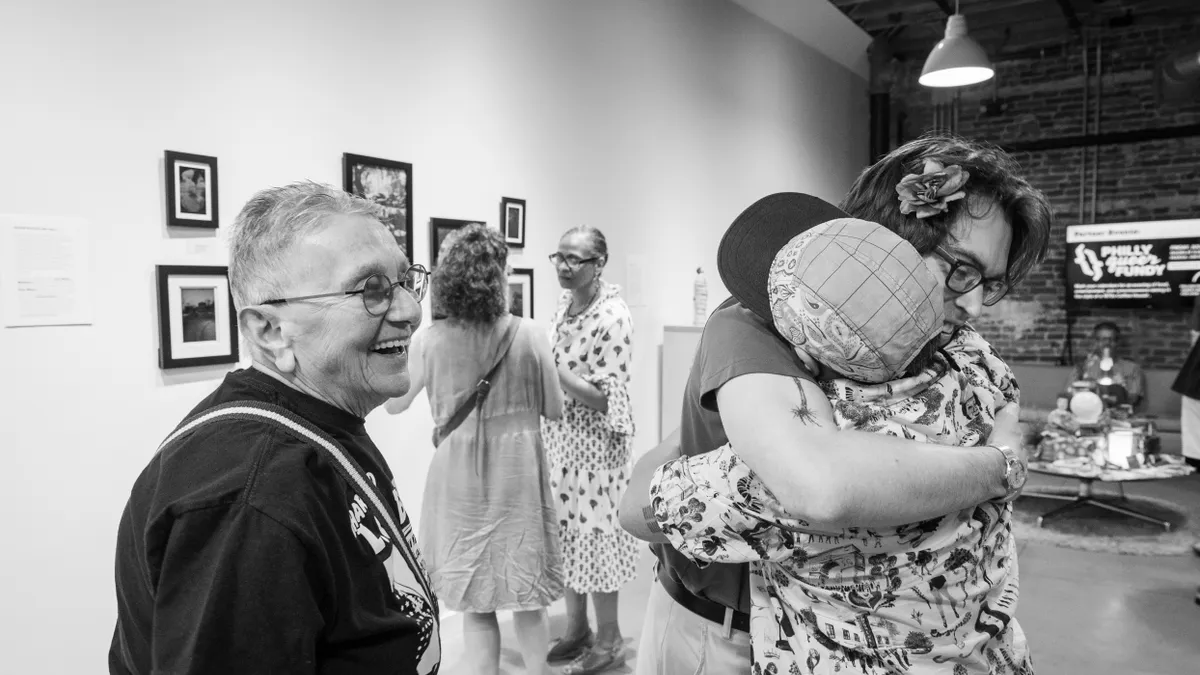
Three artists, one archive
The archive at the heart of the show is stacked with the people who actually built Philly’s movement – groups like Dyketactics, Radical Queens, and the Gay Liberation Front, and organizers including George Lakey, Tom Wilson Weinberg, and Arleen Olshan. Three Philadelphia artists were invited to answer that history in their own mediums. All three deliver.
Scarlett DeLorme – faces built to last
DeLorme shoots one-of-a-kind tintype portraits using the 19th-century wet-plate collodion process: silver-toned metal plates engineered to survive for decades, deliberately preserving faces the textbooks left out. She centers LGBT+ and disabled subjects, and she wants you to feel like family in the room, not a tourist. Photographing today’s elders, she kept running into how little the fights have changed. During Olshan’s own show earlier this year, the veteran activist told her: “It’s harder now than what it was back then.”

Justin Jain – carving them into clay
A first-generation queer Filipino artist, Jain spent months in the archives and kept hitting the same names across different groups and causes. His ceramic tiles honor those organizers; his sculptures riff on 1976 PGN covers and archival photos, including a historic shot of two men kissing in Rittenhouse Square, reimagined here through contemporary LGBT+ figures in modern dress and piercings. What he found in the elders wasn’t only rage; it was joy. As he puts it, they “pivoted to pleasure and tried to center joy as resistance.” Ceramics, he says, gave those lives a permanence a textbook or a website never could.
Amy Cousins – history as a map to the future
Working in print and fiber, Cousins uses queer history to imagine what comes next. Her work taps the long lineage of camp and dance-floor protest – the radical idea that a party can be a political act, that music and humor can live right alongside urgency. It’s the throughline of the whole show: defiance and delight, at the same time.
Why it hits so hard in 2026
The timing is doing a lot of work. This show sits inside a wider push by artists and organizers pushing back on efforts to erase marginalized stories from the nation’s 250th. With marriage equality’s opponents regrouping and trans rights under sustained pressure, a room full of 1976’s hard-won victories reads less like nostalgia and more like an instruction manual. Foster reportedly got emotional describing what those elders endured. Standing among the tintypes and the tiles, it’s easy to understand why.
Go before it’s gone
- What
- This Is (Not) a Celebration: Queer Resistance 1976/2026
- Where
- Huddle, 338 Brown St., Northern Liberties
- When
- Today only – Friday, July 3, 12-6 p.m.
- Cost
- Free
- Info
- waygay.org
Six hours. One archive. A century of people who refused to disappear. Go.